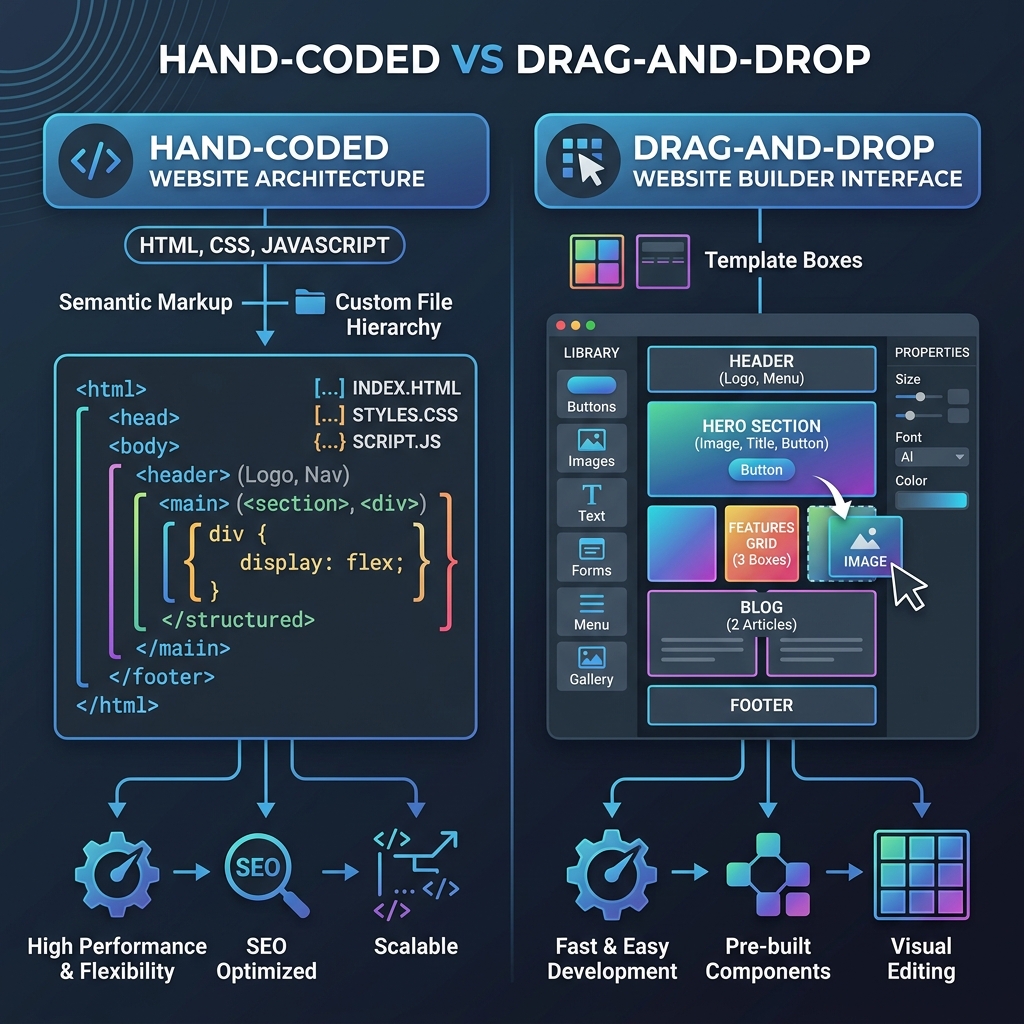
When launching a business website, founders must choose between custom-coded development and visual builders. Let's compare speed, scalability, SEO capabilities, and long-term costs.
Choosing between a custom site and a visual builder is a foundational decision that impacts your technical roadmap. While visual builders (like WordPress, Wix, or Webflow) allow you to launch simple landing pages quickly, they often introduce bloated JavaScript code and limit your ability to scale operations. Custom development offers complete control over your platform.
1. Performance & Page Speed
Visual builders rely on generic themes and plugins, which inject large amounts of unused CSS and JavaScript into your pages. This code bloat increases page load times and harms mobile user experience.
In contrast, custom websites (built with frameworks like Nuxt or React) only render the code required for each page. This clean file structure delivers fast initial loads, helping you meet Core Web Vitals targets easily.
2. Scalability & Code Ownership
As your business grows, you may need to integrate custom databases, member areas, or proprietary APIs. Visual builders often restrict these integrations, forcing you to fit your workflows into pre-built plugin constraints.
Custom development gives you complete ownership of your codebase. This allows you to scale the system horizontally, migrate hosts without restrictions, and build custom features designed specifically around your workflows.
3. Search Engine Optimization (SEO)
Search engine crawlers favor clean, fast-loading markup. Custom websites allow developers to implement clean semantic HTML, manage JSON-LD schemas, and optimize canonical tags directly. Visual builders often generate nested div wrappers and complex layouts that make crawling and indexing less efficient.
4. Long-Term Cost Analysis
While visual builders have lower startup costs, they introduce ongoing expenses like platform hosting, plugin subscriptions, and developer fees for troubleshooting plugin conflicts. A custom website requires a larger upfront investment but eliminates subscription fees and code updates, delivering a lower total cost of ownership as you scale.