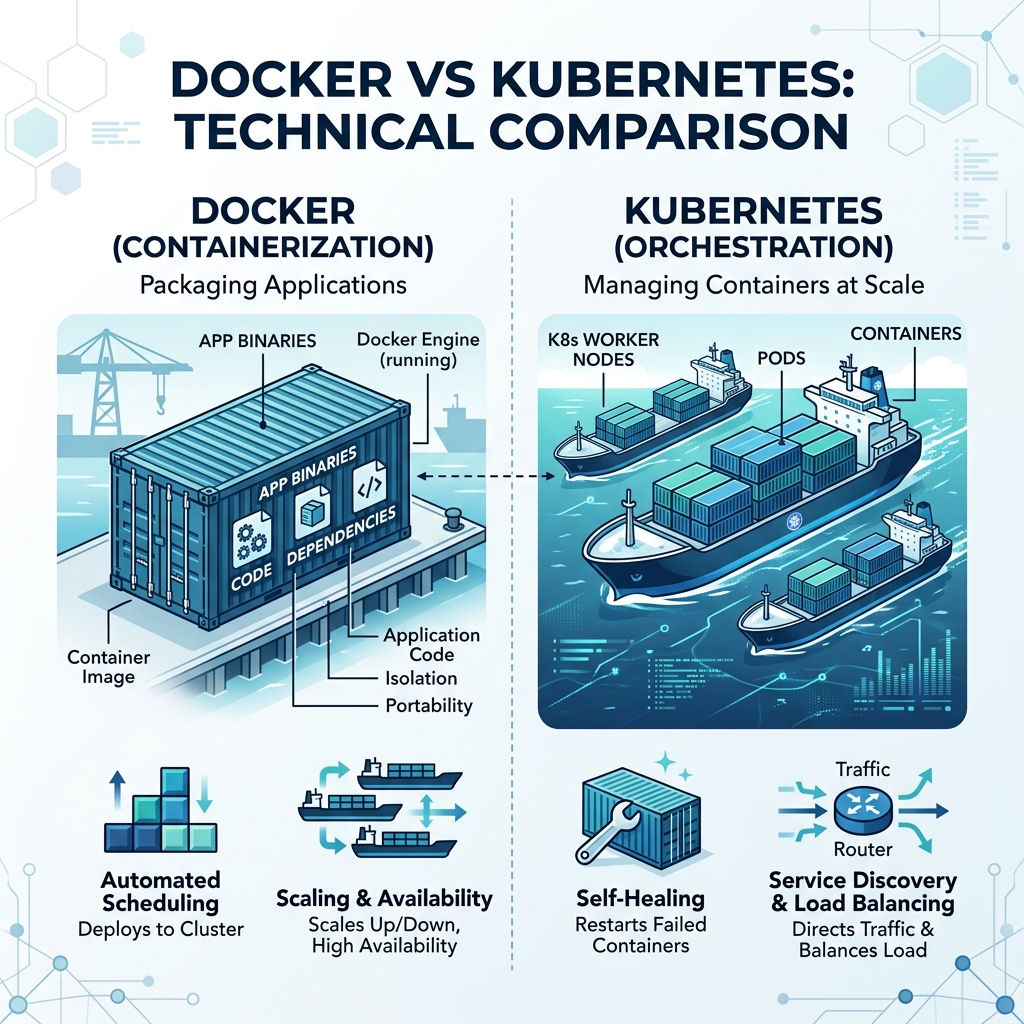
In modern DevOps workflows, Docker and Kubernetes serve different roles. Let's compare container packaging runtimes with distributed cluster orchestration.
Many developers and business leaders confuse container packaging with container orchestration. While Docker allows you to package your application and its dependencies into a single container image, running hundreds of these containers across cloud servers requires an orchestration engine like Kubernetes. Let's compare their functions.
1. Docker: Container Packaging
Docker isolates applications into lightweight units called containers:
- Consistent Environments: Packages code, runtimes, and system tools together to ensure the application runs identically on local dev and cloud servers.
- Fast Starts: Launches containerized services in milliseconds, speeding up local testing.
- Low Overhead: Shared OS kernels minimize resource usage compared to traditional virtual machines.
2. Kubernetes: Platform Orchestration
Kubernetes (K8s) manages fleets of containerized applications across cloud clusters:
- Self-Healing: Automatically restarts failed containers, replaces unhealthy nodes, and reschedules containers based on resource availability.
- Auto-Scaling: Scales containers up or down automatically to match user traffic.
- Load Balancing: Distributes network traffic across container instances to maintain fast, stable connections.
3. Docker Compose vs. Kubernetes
For local development, tools like Docker Compose coordinate multi-container applications easily on a single computer. However, running Compose in production lacks cluster failover and auto-scaling capabilities. Kubernetes addresses this by managing container deployments across multiple cloud servers.
4. How to Choose
You do not choose between them; they are designed to work together. Use Docker to package your services and maintain consistent development environments. Transition to Kubernetes when you need to deploy, scale, and manage those containers across production cloud clusters.