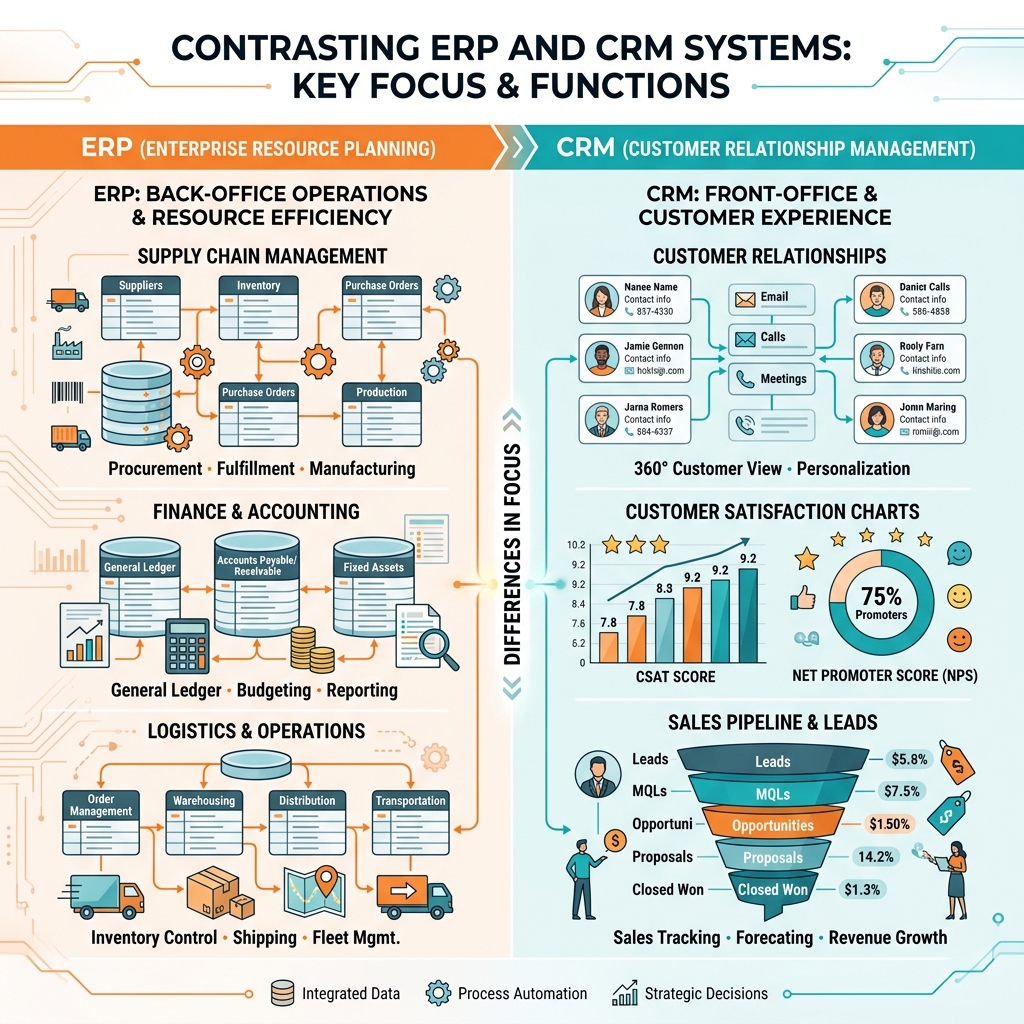
While ERP and CRM systems manage business databases, they focus on different operational areas. Let's compare back-office supply chain integrations with front-office customer pipelines.
Many growing businesses struggle to understand whether they need an Enterprise Resource Planning (ERP) system or a Customer Relationship Management (CRM) platform. Implementing the wrong tool can lead to data fragmentation. Let's look at the database goals and integration strategies of each system.
1. ERP: The Back-Office Engine
An ERP system consolidates operations across the entire organization into a single database. It handles internal processes such as:
- Supply Chain & Logistics: Tracking raw materials, procurement, and shipping schedules.
- Financial Ledger: Managing billing transactions, invoices, and double-entry accounting records.
- Inventory Management: Monitoring SKU volumes and warehouse stock levels in real time.
2. CRM: The Front-Office Pipeline
A CRM system focuses exclusively on the customer lifecycle and sales funnel. It manages external integrations such as:
- Lead Tracking: Monitoring prospective clients as they progress through the sales pipeline.
- Customer Communication: Storing histories of client emails, calls, and support interactions.
- Marketing Automation: Segmenting user lists and running targeted email campaigns.
3. Database Schema Integrations
In a modern enterprise architecture, ERP and CRM systems do not run in isolation. Instead, they share reference keys.
For example, when a salesperson closes an opportunity in the CRM system, an API webhook must trigger the ERP database to generate an invoice and allocate warehouse resources. Keeping these keys aligned ensures data consistency across departments.
4. How to Choose
If your primary bottleneck is sales tracking and customer engagement, prioritize a CRM. If your challenges involve supply chain management, complex inventory, and internal accounting, you need an ERP. Most scaling enterprises eventually integrate both systems into their tech stack.