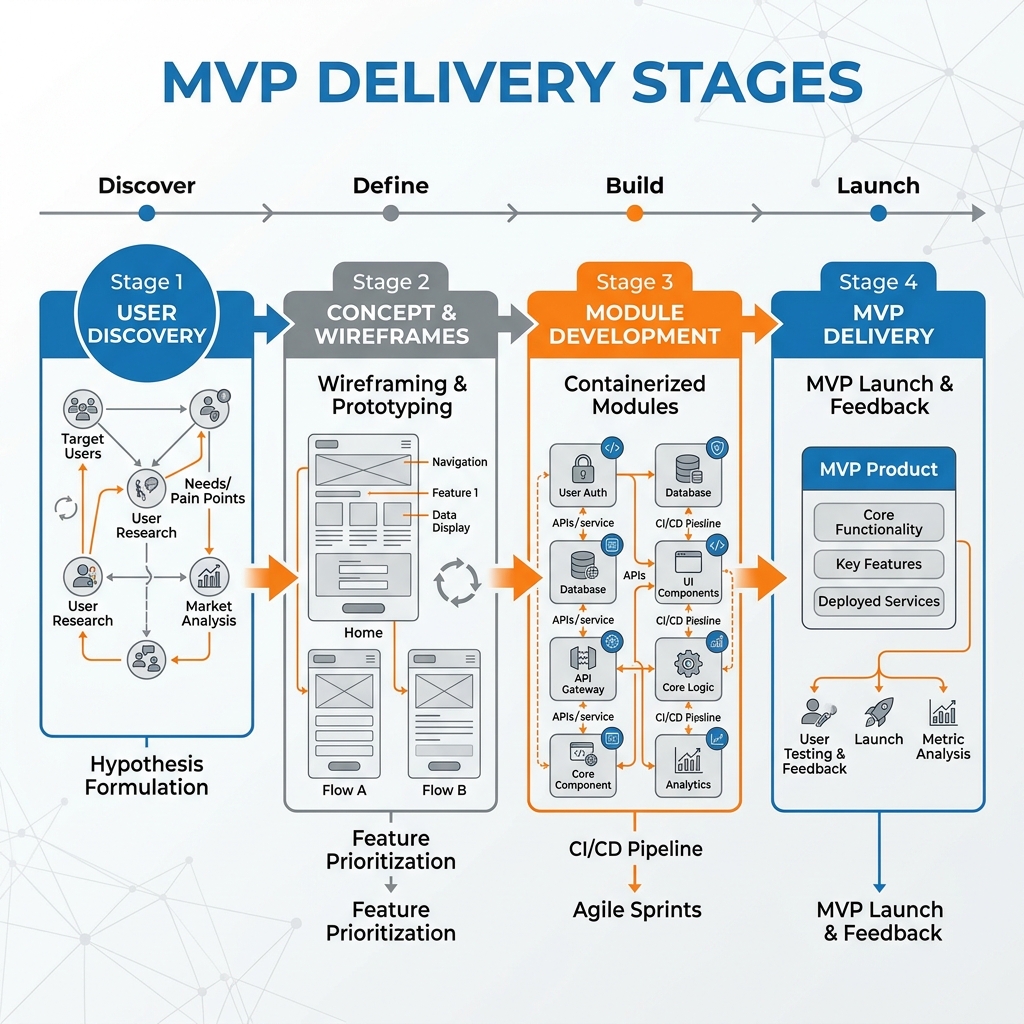
Launching a Minimum Viable Product (MVP) helps startups validate assumptions and gather user feedback quickly. Let's analyze feature prioritization, development speed, and validation workflows.
Building a software product requires balancing features with delivery speed. Founders often waste resources developing complex systems that markets do not actually need. An MVP addresses this by focusing exclusively on the core value proposition. Let's look at how to build and launch one efficiently.
1. Defining Your Value Proposition
An MVP should address one main problem for your target users. To clarify this focus, ask:
- What is the primary action a user needs to complete on the platform?
- What is the simplest workflow that solves their core problem?
- Which secondary features (such as notifications or chat) can be deferred to later phases?
2. Agile Sprints & Scoping
Keep development timelines short—ideally between 4 and 8 weeks. This requires dividing the product backlog into 1-to-2 week sprints, using continuous integration pipelines to build and deploy features incrementally, and focusing on functional workflows rather than extensive design customization.
3. Launching and Tracking Usage Metrics
Once your MVP is deployed, track user engagement directly. Use simple analytics setups to measure signup conversion rates, tracking features users interact with most, and monitoring drop-off points in your conversion funnel to inform your product roadmap.
4. Collecting and Implementing Feedback Loops
An MVP is designed to start a feedback loop. Implement easy channels (like feedback forms or direct email links) to gather user suggestions. Reviewing this feedback helps you refine requirements and prioritize new features based on real-world usage rather than assumptions.