Laravel 13 has officially arrived, bringing unified AI agent primitives, first-party JSON:API resources, semantic vector search, queue routing, and expanded attribute coverage.
Laravel 13 continues the framework's annual release cadence, delivering major capabilities while prioritizing zero-friction upgrades. For engineering teams building SaaS, custom ERP systems, and cloud architectures, the native AI SDK and built-in vector search features simplify the backend stack significantly.
What Is Laravel 13?
Released on March 17, 2026, Laravel 13 introduces a suite of first-party packages and improvements that turn the framework into an AI-native stack. Key features include the Laravel AI SDK, JSON:API compliant resource wrappers, semantic query helpers, centralized queue routing, and new request forgery security additions.
| Version | PHP Range | Release Date | Bug Fixes | Security Patches |
|---|---|---|---|---|
| Laravel 11 | 8.2 - 8.4 | March 12, 2024 | Sep 3, 2025 | March 12, 2026 |
| Laravel 12 | 8.2 - 8.5 | Feb 24, 2025 | Aug 13, 2026 | Feb 24, 2027 |
| Laravel 13 | 8.3 - 8.5 | March 17, 2026 | Q3 2027 | March 17, 2028 |
Laravel 13 vs Laravel 12: Comparison
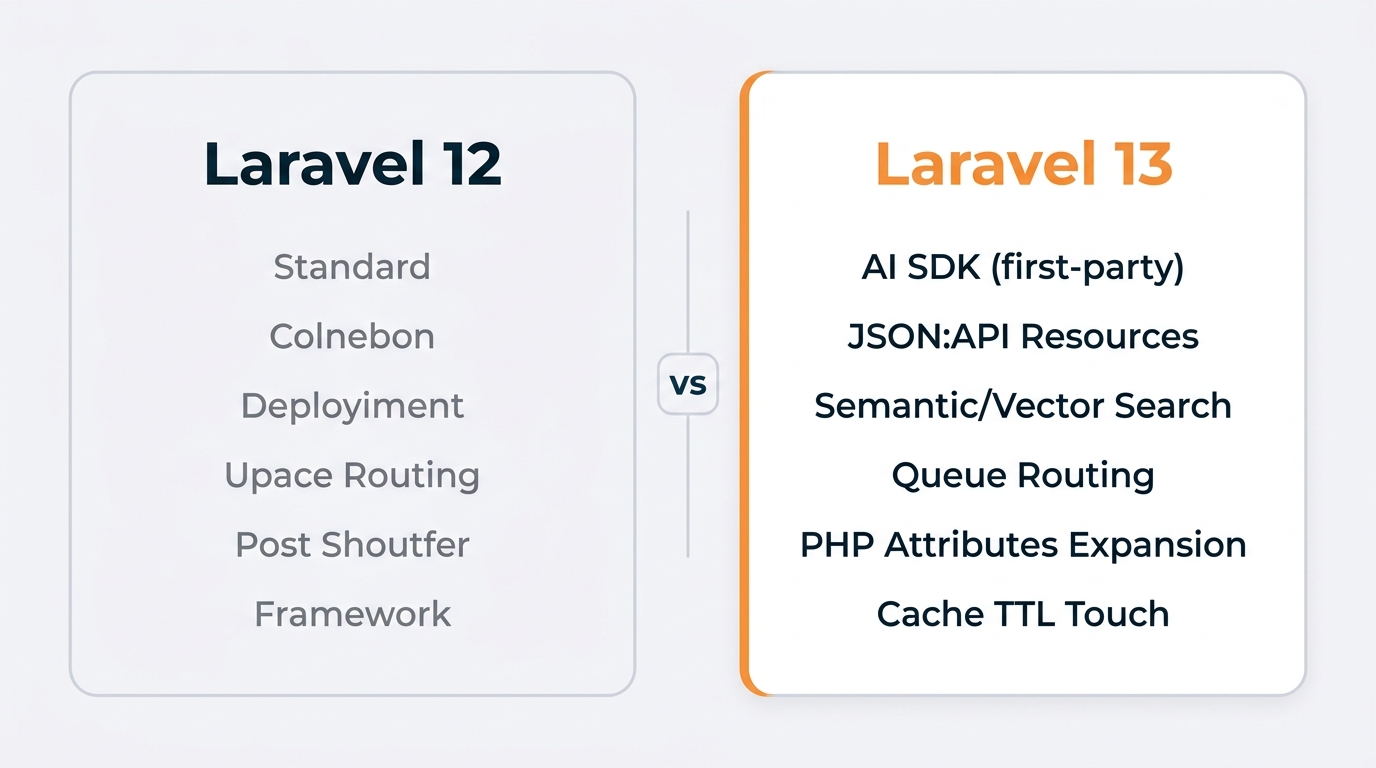
New Feature: First-Party AI SDK
The new Laravel AI SDK provides a unified wrapper API for text generation, agent building, voice actions, and embeddings. Developers can switch LLM providers (OpenAI, Anthropic, Gemini, local models) purely from environment configuration without rewriting application code.
1. Tool-Calling Agent Prompting
use App\Ai\Agents\SalesCoach;

$response = SalesCoach::make()->prompt('Analyze this transcript for customer objections...');
return (string) $response;
2. Vector Embeddings Generation
use Illuminate\Support\Str;

$embeddings = Str::of('Multi-tenant SaaS architecture security practices')->toEmbeddings();
New Feature: Semantic / Vector Search
Laravel 13 introduces native vector query capabilities that hook directly into PostgreSQL and the pgvector extension. You can now execute semantic query evaluations right inside the standard Eloquent builder:
use Illuminate\Support\Facades\DB;

$documents = DB::table('documents')
    ->whereVectorSimilarTo('embedding', 'Best practices for Laravel queue workers')
    ->limit(10)
    ->get();
New Feature: Centralized Queue Routing
Rather than configuring connections and queues individually inside each Job class, Laravel 13 allows centralizing queue routes inside your App Service Providers.
use Illuminate\Support\Facades\Queue;

Queue::route(ProcessInvoice::class, connection: 'redis', queue: 'invoices');
Queue::route(SendWelcomeEmail::class, connection: 'sqs', queue: 'emails');
New Feature: First-Party JSON:API Resources
First-party JSON:API resources are now built into Illuminate\Http. This standardizes response outputs matching the JSON:API specifications, handling compound relationship inclusions, sparse fieldsets, and automated headers natively.
New Feature: Expanded PHP Attributes
Common routing, middleware, policy, and retry concerns are now configured colocated with methods using attributes:
#[Middleware('auth')]
class CommentController
{
    #[Middleware('subscribed')]
    #[Authorize('create', [Comment::class, 'post'])]
    public function store(Post $post) { /* ... */ }
}
Breaking Changes and Upgrade
The typical Laravel 13 upgrade takes roughly 10 minutes. The primary requirements include bumping PHP to version 8.3+, updating dependencies in composer.json, renaming the CSRF middleware class to PreventRequestForgery, and reviewing cache serialization classes.
Upgrade Step-by-Step
- Install Laravel Boost 2.0 globally or in dev dependencies.
- Run
/upgrade-laravel-v13in your AI-assisted CLI or editor. - Verify PHP 8.3+ is configured locally and in target servers.
- Test cache serialization allowed classes configuration.