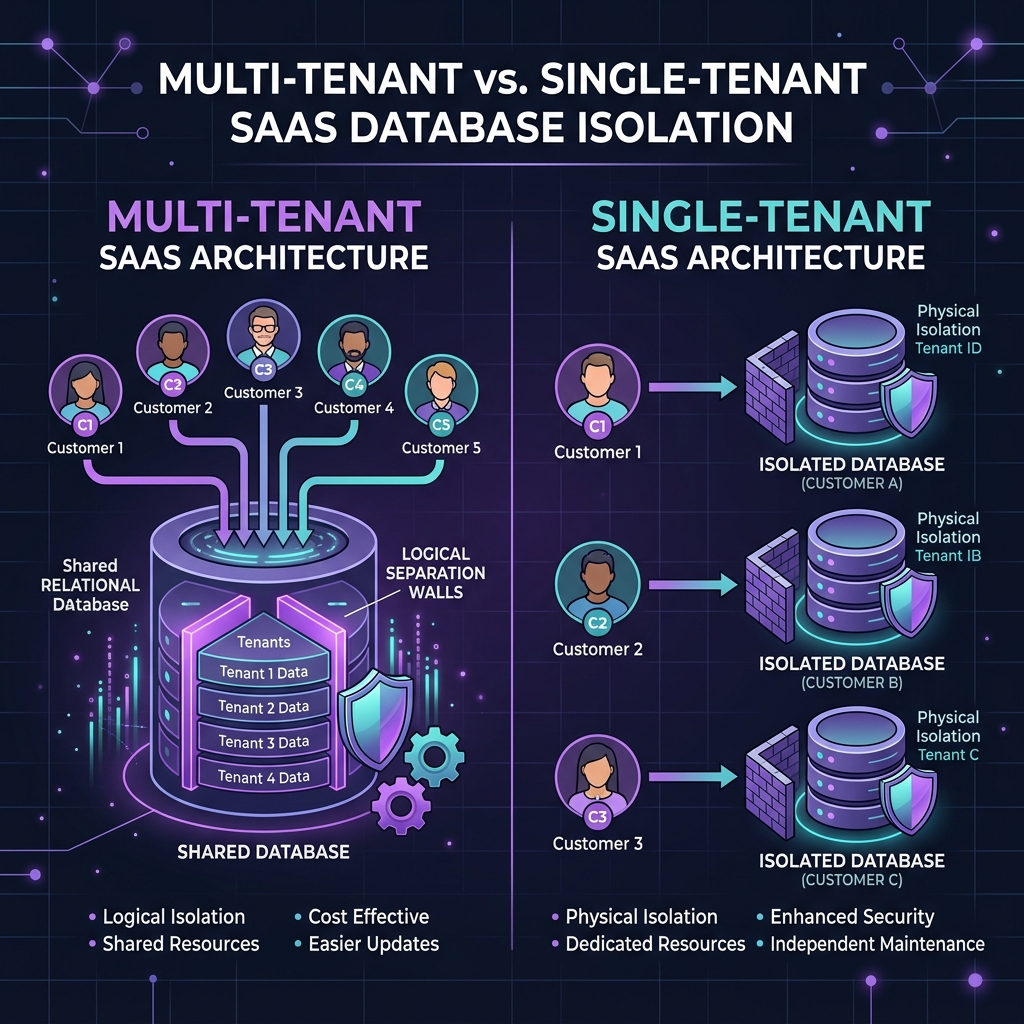
When designing a SaaS application, database isolation is a key architectural decision. Let's compare the security, scaling, and cost characteristics of multi-tenant and single-tenant models.
SaaS platforms must protect patient or customer data while managing infrastructure costs. The choice between multi-tenant (shared infrastructure) and single-tenant (dedicated infrastructure) configurations impacts database performance, security compliance, deployment overhead, and licensing models.
1. Multi-Tenant Architecture: Shared Infrastructure
In a multi-tenant setup, all customers (tenants) share the same database servers and compute resources:
- Logical Isolation: Data is segregated within shared tables using a
tenant_idcolumn and global query filters. - Cost Efficiency: Running a shared pool of cloud servers minimizes infrastructure costs, especially for smaller accounts.
- Simplified Updates: Database schema migrations and code updates are applied once across all tenants.
2. Single-Tenant Architecture: Dedicated Infrastructure
In a single-tenant setup, each customer receives an isolated database instance and dedicated cloud compute resources:
- Physical Isolation: Patient or enterprise data is physically isolated on separate servers, minimizing data leak risks.
- Customization: Individual tenants can run custom schema designs or database configurations without affecting others.
- High Compliance: Simplifies compliance audits for regulated industries (like healthcare or finance) by keeping data physically isolated.
3. Cost and Performance Analysis
While single-tenant setups offer high security, they require larger infrastructure budgets and increase DevOps overhead because each instance must be updated and backed up separately.
Multi-tenant systems are more cost-effective and easier to manage but require strict security controls in your application code to prevent data leaks.
4. How to Choose
Choose a multi-tenant architecture for standard SaaS products where cost-effective scaling and simple maintenance are priorities. Opt for a single-tenant model for enterprise clients in highly regulated industries who require strict data isolation and custom security controls.