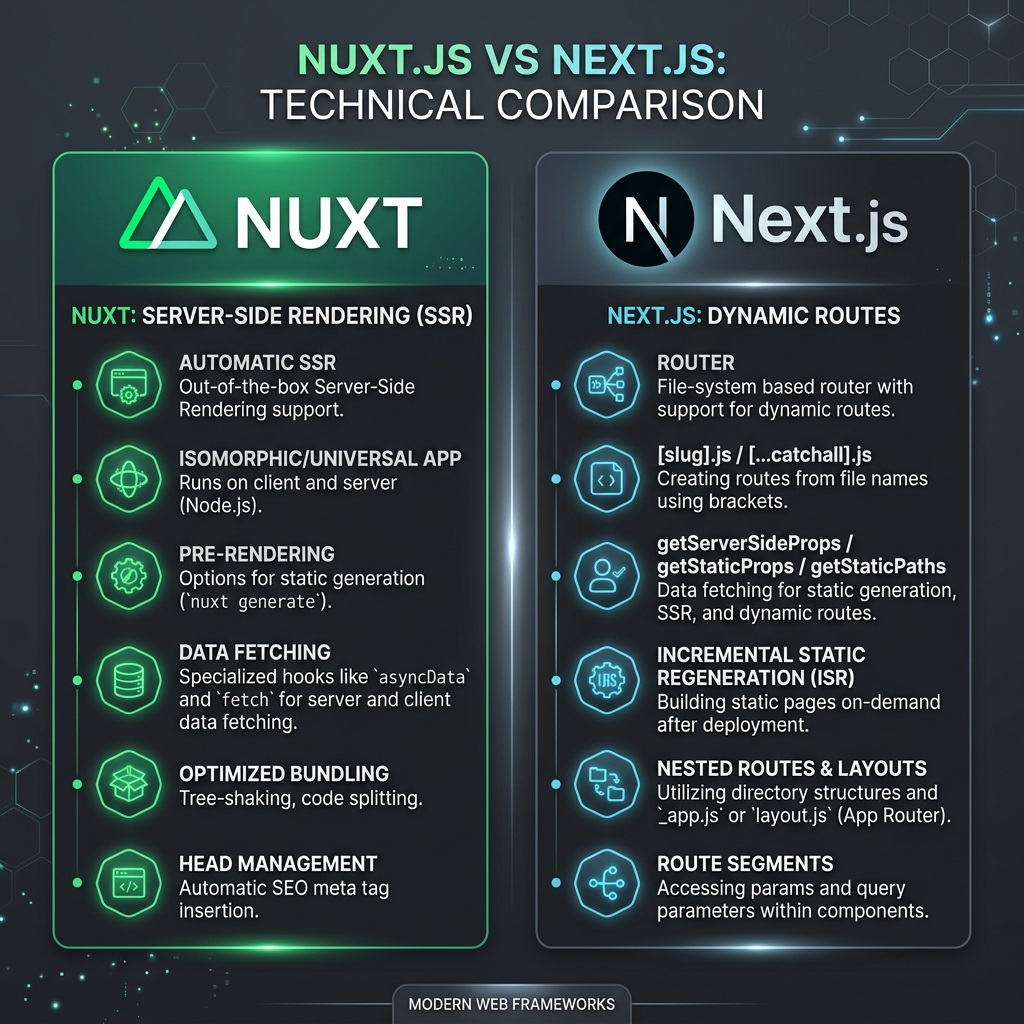
Nuxt and Next.js are the leading frameworks for building modern web applications. Let's compare server-side rendering, routing mechanisms, and data fetching models.
Selecting a frontend framework impacts your development workflow and site performance. While Nuxt (built on Vue) and Next.js (built on React) offer features like Server-Side Rendering (SSR) and Static Site Generation (SSG), they use different file structures and configurations. Let's compare their architectures.
1. Nuxt: Vue-Powered Simplicity
Nuxt simplifies web development with sensible defaults and automated configurations:
- File-System Routing: Automatically generates routing maps based on files inside the
pages/directory. - Auto-Imports: Automates imports for Vue composables, components, and helper APIs, reducing boilerplate code.
- Flexible Rendering: Supports SSR, SSG, and Single Page Application (SPA) configurations out of the box.
2. Next.js: React-Powered Scale
Next.js is the popular framework for building React-based web applications, offering high customizability and enterprise features:
- App Router Architecture: Integrates React Server Components (RSC) to minimize client-side JavaScript.
- Data Fetching: Implements granular caching and Incremental Static Regeneration (ISR) to update static pages on demand.
- Vercel Integration: Optimizes deployments, edge functions, and analytics dashboards when hosting on Vercel.
3. Performance and Developer Experience
Next.js's React Server Components model reduces client-side bundles significantly by rendering UI elements on the server. However, Nuxt's auto-import system and clean configuration file make it highly developer-friendly, offering fast build times and a smooth development experience.
4. How to Choose
Choose Next.js if your team has deep React experience, you want to utilize server components, or you plan to host your application on Vercel. Choose Nuxt if you prefer Vue's clean template structure, want to minimize boilerplate code, or need a fast, simple setup to launch your web application.