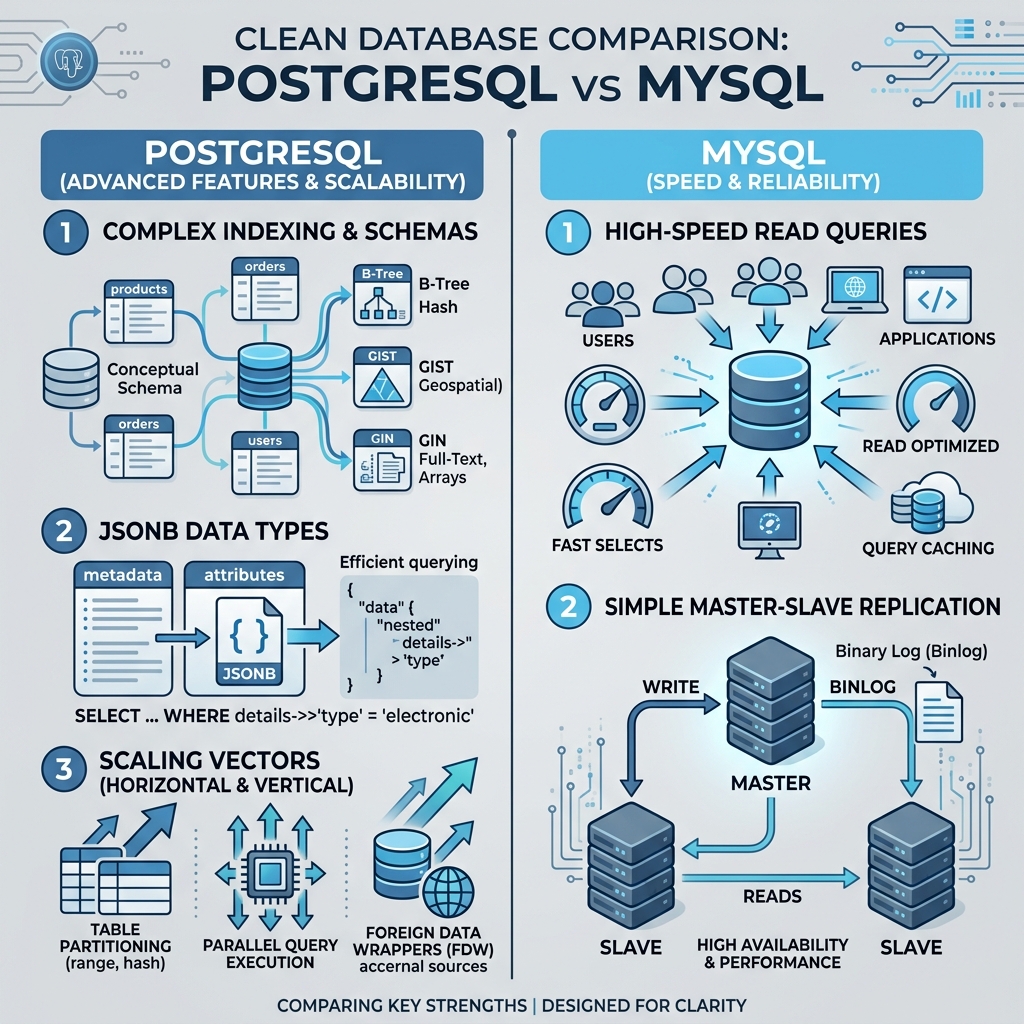
Choosing between PostgreSQL and MySQL shapes your application database architecture. Let's compare JSONB indexing, ACID compliance, and scaling strategies.
Selecting a database engine goes beyond comparing basic SQL queries. For modern web applications, the choice between PostgreSQL and MySQL impacts data normalization, query concurrency, geographic search, and JSON payload handling. Let's compare their core capabilities.
1. PostgreSQL: Object-Relational Powerhouse
PostgreSQL is an advanced, enterprise-grade object-relational database. It is optimized for complex queries, high concurrency, and data integrity:
- JSONB Support: Stores and indexes unstructured JSON data efficiently, allowing you to run complex document queries alongside relational tables.
- Advanced Indexing: Supports GIN, GiST, and partial indexes to speed up geographic, full-text, and custom searches.
- Strict ACID Compliance: Enforces relational integrity out of the box, making it ideal for financial ledger transactions.
2. MySQL: High-Speed Read Engine
MySQL is the world's most popular open-source relational database. It is widely used for read-heavy applications (like content platforms and web stores):
- Optimized for Reads: Features simple, fast read queries and low CPU overhead for standard CRUD operations.
- Replication Topologies: Offers simple, robust master-slave replication setups to distribute read traffic.
- Widespread Hosting: Supported out of the box by nearly all web hosts and managed database services.
3. Query Optimization and JSON Comparison
While MySQL has improved its JSON features, PostgreSQL's JSONB format remains superior for complex querying because it stores data in a binary format, allowing you to index nested keys directly. PostgreSQL also handles complex multi-table joins more efficiently, whereas MySQL excels in simple, high-speed read transactions.
4. How to Choose
Choose MySQL for standard web applications, read-heavy sites, or when your hosting environment requires simple database setup. Opt for PostgreSQL if your application handles complex schemas, requires GIS coordinates, processes JSON payloads, or manages high-concurrency write transactions (such as financial platforms or analytical engines).