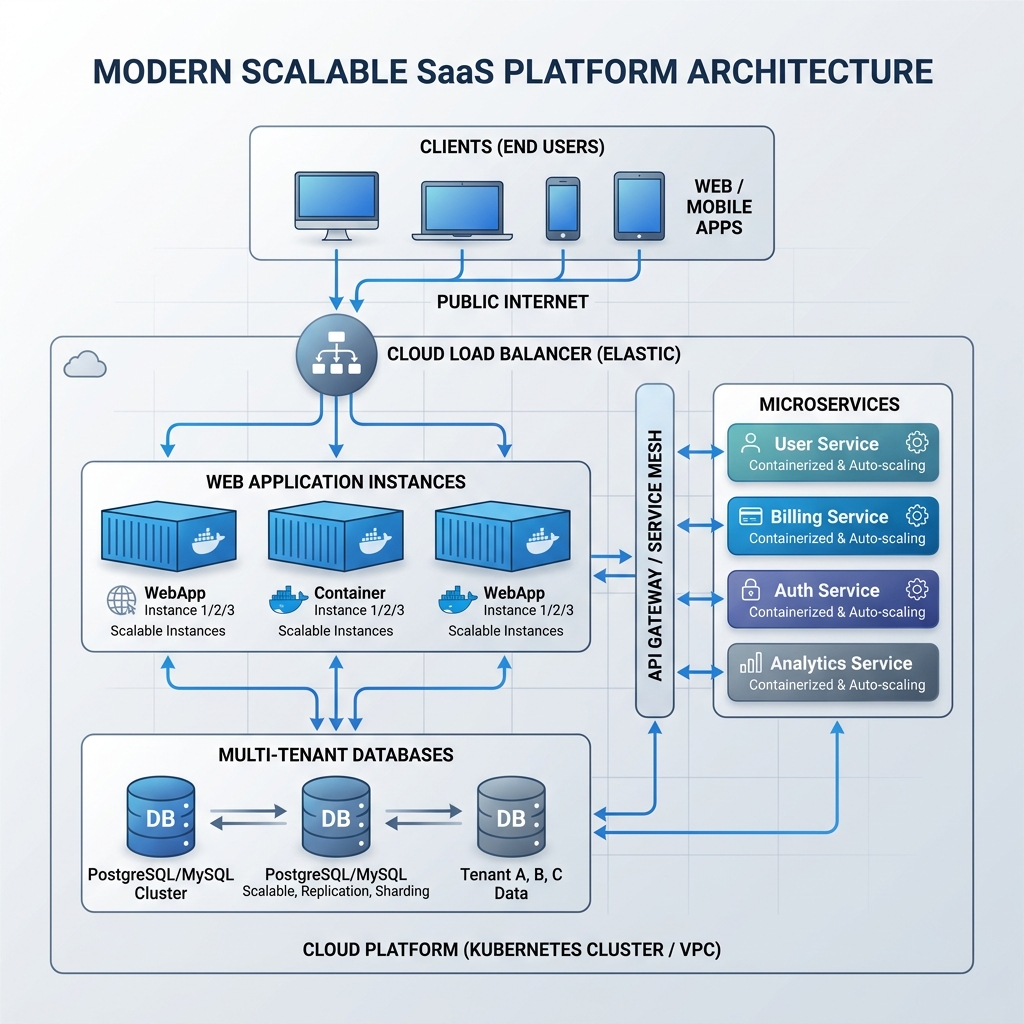
Building a Software-as-a-Service (SaaS) application requires careful planning around scaling, microservices, and database optimization. Here is a technical blueprint for SaaS architecture.
SaaS platforms must handle multi-tenant isolation, manage heavy user loads, and guarantee high availability. A monolithic structure often struggles to scale as tenant databases grow. Let's look at the architectural patterns and scaling strategies that support enterprise SaaS platforms.
1. Decoupled Routing & API Gateways
A scalable SaaS platform should route client requests through an API Gateway. The gateway handles routing, rate limiting, and SSL termination before requests reach your web application.
Decoupling these features keeps your core services lightweight and allows you to scale backend nodes (using container tools like Docker and Kubernetes) independently to match user traffic.
2. Microservices and Event-Driven Pipelines
As a SaaS platform grows, monolithic codebases become difficult to maintain. Transitioning to a microservices architecture involves dividing business logic into separate, independent services (such as authentication, billing, and reporting modules).
These services communicate asynchronously through message queues (such as RabbitMQ or Redis). This event-driven pattern ensures that a delay in generating reports does not impact checkout or login speeds.
3. Database Sharding and Caching Layers
Database queries are a common performance bottleneck. Implement these practices to optimize database performance:
- Database Sharding: Distribute tenant data across multiple database servers to prevent single-instance performance issues.
- Replication: Direct read traffic to read-only replica servers, keeping the primary server dedicated to write transactions.
- Distributed Caching: Cache frequently accessed configurations and tenant metadata in memory (using Redis) to reduce database load.
4. Implementing Granular Monitoring
Maintaining SaaS availability requires real-time system monitoring. Set up tracing tools to track request latency across microservices, monitor database query execution times, and log system metrics (like CPU and memory usage) to identify and resolve performance issues quickly.