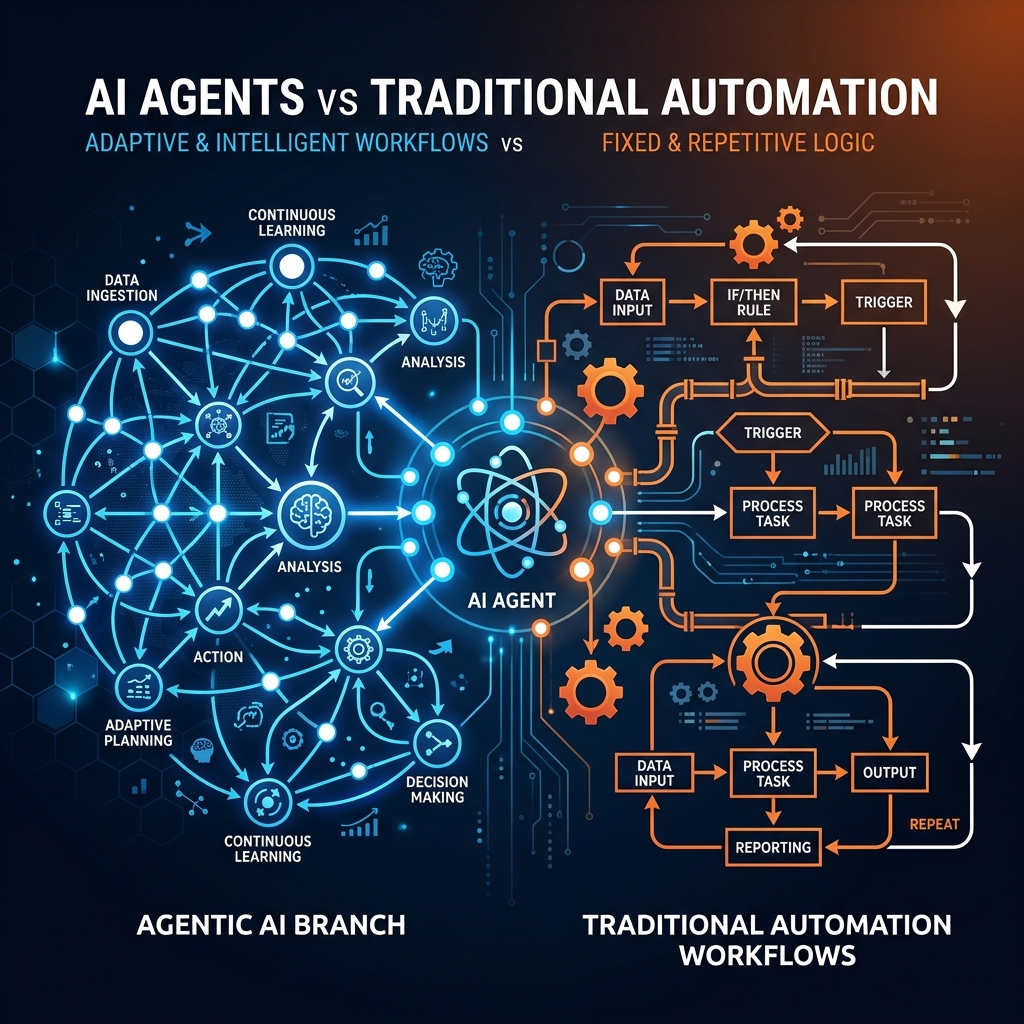
Understanding the difference between deterministic scripting and autonomous AI agent loops is crucial for modern enterprise automation. Let's compare cognitive planning structures, tool-use APIs, and execution costs.
For years, businesses have automated tasks using scripts, Robotic Process Automation (RPA), and hard-coded workflows. While these systems are highly efficient for structured, repetitive tasks, they fail when encountering unexpected data formats or system changes. AI agents introduce a dynamic approach to automation.
1. Traditional Automation: Rules-Based Logic
Traditional automation relies on explicit if-then logic:
- Deterministic Execution: Workflows follow pre-defined branches. If a layout changes or an API response shifts, the workflow breaks.
- No Adaptation: The system cannot interpret unstructured data (such as emails or documents) without explicit parsing rules.
- Low Overhead: Once built, running traditional scripts requires minimal computing resources and runs instantly.
2. AI Agents: Cognitive Execution Loops
AI agents use Large Language Models (LLMs) to manage execution dynamically. Instead of following a fixed script, an agent runs within a continuous loop:
// The Agentic Loop Core
while ($agent->hasGoal()) {
    $thought = $agent->plan($state);
    $action = $agent->chooseTool($thought);
    $result = $action->execute();
    $state = $agent->reflect($result);
}
This cognitive loop lets agents evaluate unexpected errors, call tool APIs dynamically, and format unstructured payloads on the fly.
3. Comparison Matrix
| Feature | Traditional Automation | AI Agents (Agentic AI) |
|---|---|---|
| Logic Type | Deterministic (Pre-written rules) | Probabilistic (LLM-guided reasoning) |
| Handling Errors | Fails immediately (needs code correction) | Self-correcting (evaluates errors and retries) |
| Data Input | Highly structured only (CSV, database tables) | Unstructured (natural language, PDFs, images) |
| Runtime Cost | Extremely low (typical CPU execution) | Variable (LLM token calls and GPU overhead) |
4. When to Use Which Architecture
Choosing between scripts and agentic systems depends on your automation goals:
- Use Traditional Automation if: You are executing structured tasks (like daily data imports, cron backups, or billing transactions) where inputs are predictable and errors must be prevented.
- Use AI Agents if: You are handling unstructured inputs (such as analyzing customer feedback emails, generating complex responses, or executing multi-step research tasks) that require decision-making and error-recovery.